

#BLOG · 3 September 2026
How do you know if you need braces or aligners as an adult and what does orthodontic treatment start with?
Do you need orthodontic treatment as an adult? The short answer
As an adult, you probably need orthodontic treatment if you notice crowded or rotated teeth, gaps that appear or widen between teeth, an incorrect bite (upper and lower teeth do not meet evenly), visible wear on the edges of the teeth, or difficulty brushing and flossing in certain areas. The precise diagnosis can only be made by the orthodontist, after an orthodontic consultation with x-rays and bite analysis. The good news is that orthodontics in adults it works at any age, and in Bucharest you now have discreet options, from aesthetic fixed appliances to invisible aligners.
In our clinic in Sector 6, we see more and more adult patients, between 25 and 55 years old, who choose to correct their smile. Some put off the decision for years because they associate braces with adolescence. In reality, teeth move just as predictably in adulthood, but the planning must take into account the particularities of each case: existing prosthetic work, the condition of the gums, possible extractions from the past.
In this guide, we go through the specific signs you can check for yourself, explain when aligners are enough and when a fixed appliance is needed, then describe step by step what the first orthodontic consultation looks like, so you know exactly what to expect.
Checklist: signs that indicate the need for orthodontics in adults
No isolated sign automatically means you need braces. But if you check off two or more points from the list below, an orthodontic evaluation is worth scheduling.
Visible signs, which you notice in the mirror
These are the most common reasons why patients come to us:
- Dental crowding: teeth overlap, are rotated or pushed out of the arch. In adults, inferior frontal crowding often increases with age.
- Spaces between teeth (diastemas): either always present or recently appeared. New spaces can signal tooth migration or periodontal problems.
- Prominent front teeth: the upper incisors protrude far forward, sometimes being exposed to trauma.
- Deviated midline: the center of the upper teeth does not line up with the center of the lower teeth.
- Teeth that have migrated after an extraction: when a missing tooth has not been replaced, the neighbors lean towards the free space, and the antagonist (the tooth on the opposite arch) descends or ascends.
Functional signs, which you feel
Orthodontics is not just about aesthetics. These functional symptoms are equally important:
- Incorrect bite: deep bite (the upper teeth almost completely cover the lower ones), open bite (the front teeth do not touch when you close the mouth) or crossbite (the lower teeth protrude from the upper ones in certain areas).
- Uneven tooth wear: blunt edges, small chips or thinned enamel on some teeth. An unbalanced bite distributes forces incorrectly.
- Hygiene difficulties: areas where the dental floss does not enter or breaks, overlapped teeth where bacterial plaque and tartar constantly accumulate.
- Frequent cheek or tongue biting during the meal.
- Temporomandibular joint discomfort: popping, muscle fatigue in the morning or tension in the jaw area, which may be related to the position of the teeth.
- Localized gingival sensitivity: the gum recedes faster on teeth positioned outside the arch.
If you also suspect a gum problem, such as frequent bleeding or receding, it is important that this is treated before orthodontics. In our clinic, we evaluate the periodontal condition at each consultation, and when necessary, we first recommend one laser periodontal treatment to stabilize the gums.
Fixed braces or invisible aligners: how do we choose for an adult?
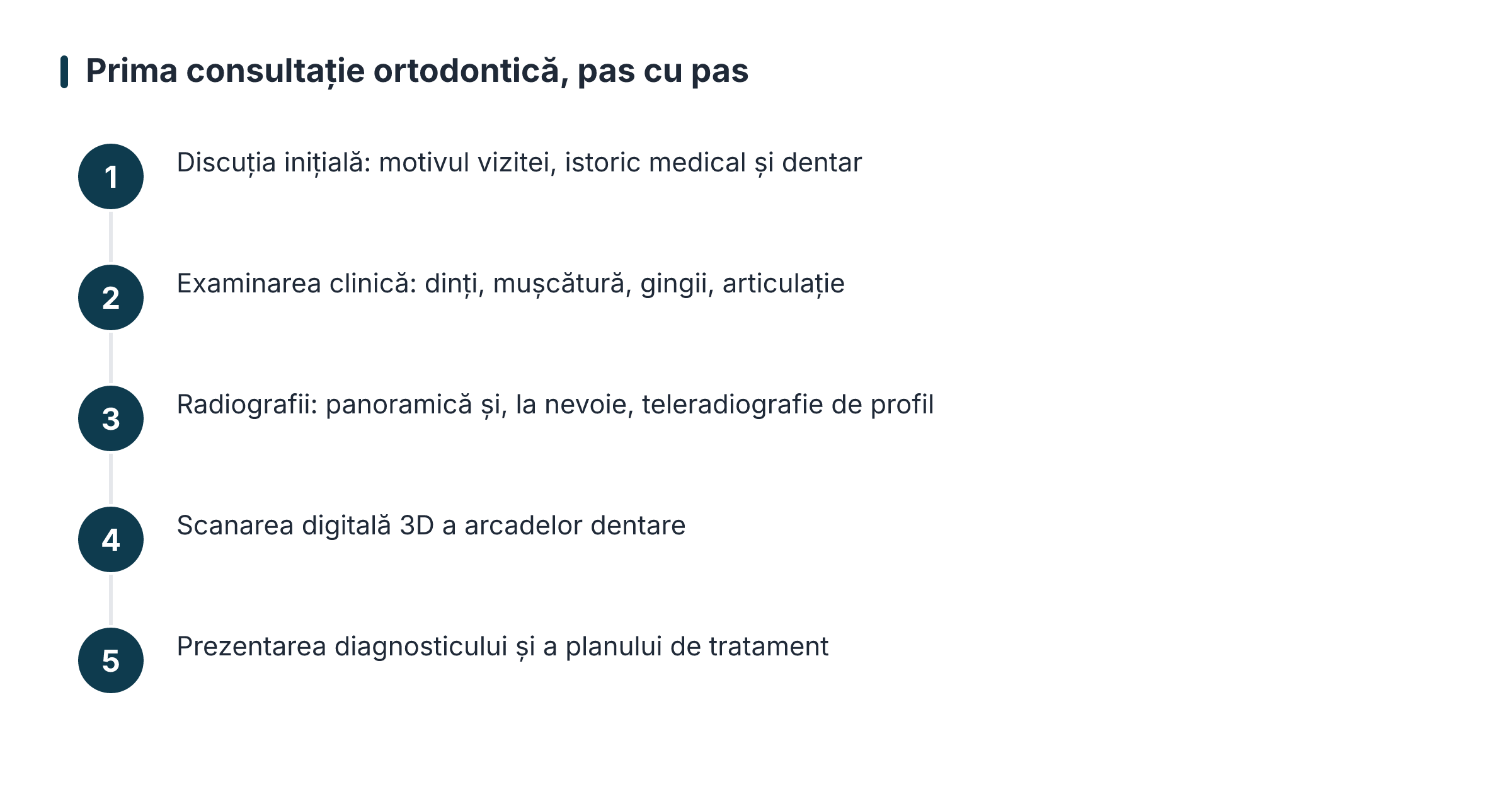
Both options move the teeth through controlled, gradually applied forces. The difference lies in the way the forces are applied, in the aesthetics and in the patient's lifestyle.
Fixed dental appliance (metallic or ceramic, more discreet) is glued to the teeth and works continuously, without depending on the discipline of the patient. It remains the option of choice for certain complex movements: severe rotations, important vertical corrections or cases that require fine root control.
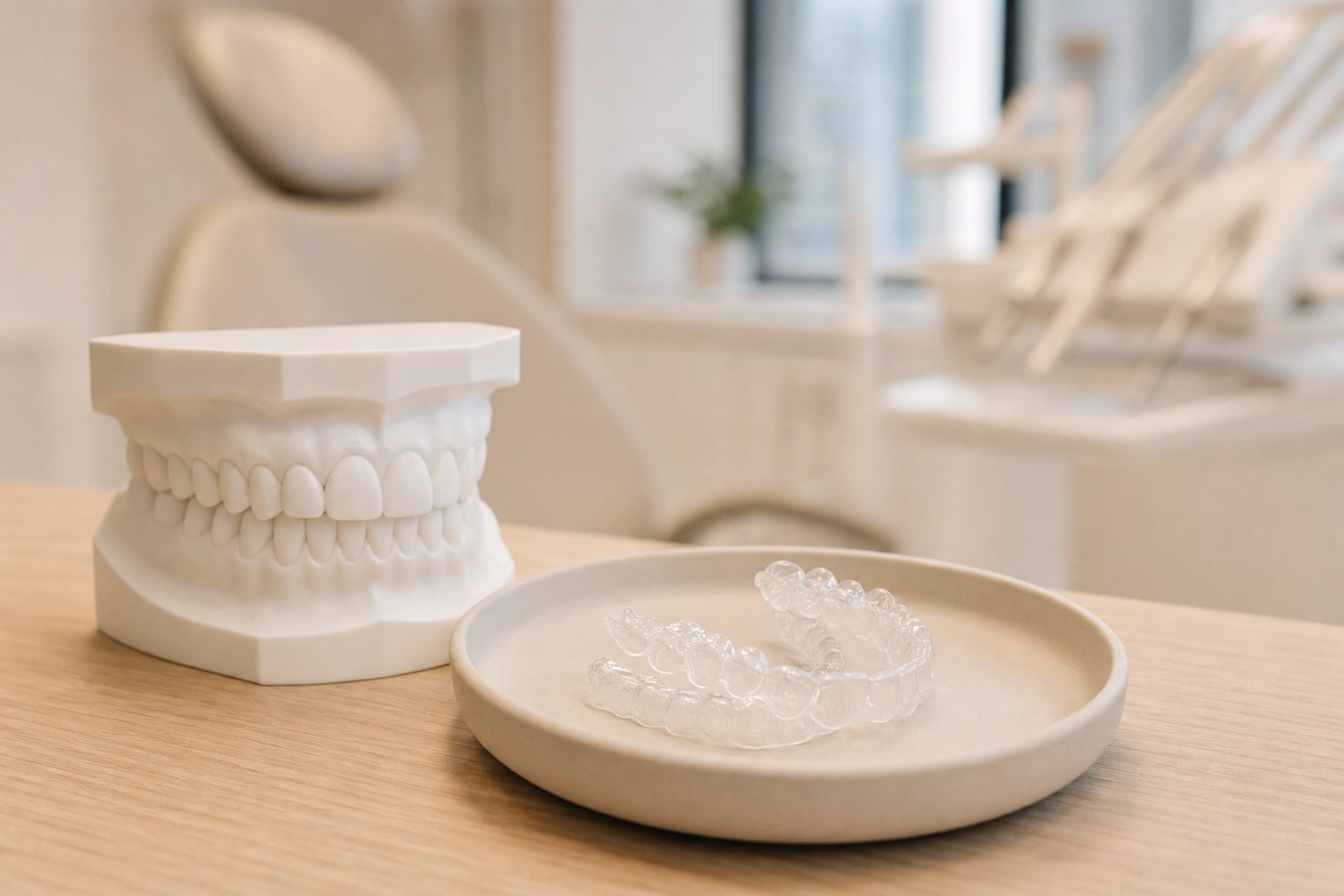
Invisible aligners they are transparent glasses, made on the basis of a digital scan, worn 20-22 hours a day and changed every one to two weeks. They are removable, so you eat and brush your teeth normally, and aesthetically they are almost imperceptible. For many working adults, this is the deciding factor. In our clinic we also work with Spark aligners, appreciated for the clarity of the material and the precision of digitally planned movements. Details about this treatment can be found on the dedicated page invisible braces in Sector 6.
Some benchmarks from our practice:
- Mild to moderate crowding, spaces and relapses after orthodontic treatment in adolescence usually respond very well to alignment.
- Complex cases may require fixed appliance or a combination of techniques.
- Aligners require discipline: If you know you won't be wearing them constantly, talk openly with your orthodontist about the fixed alternative.
The final decision is not taken from the catalog, but after the analysis of the orthodontic documentation. Sometimes the patient wants aligners and they are the right solution. Other times, we explain why his treatment plan needs a different approach, and this transparency saves months of ineffective treatment.
How to start orthodontic treatment: the first step-by-step consultation
Many patients postpone their orthodontic consultation because they do not know what to expect. Here's how the first visit to an orthodontic clinic for adults in Bucharest goes:
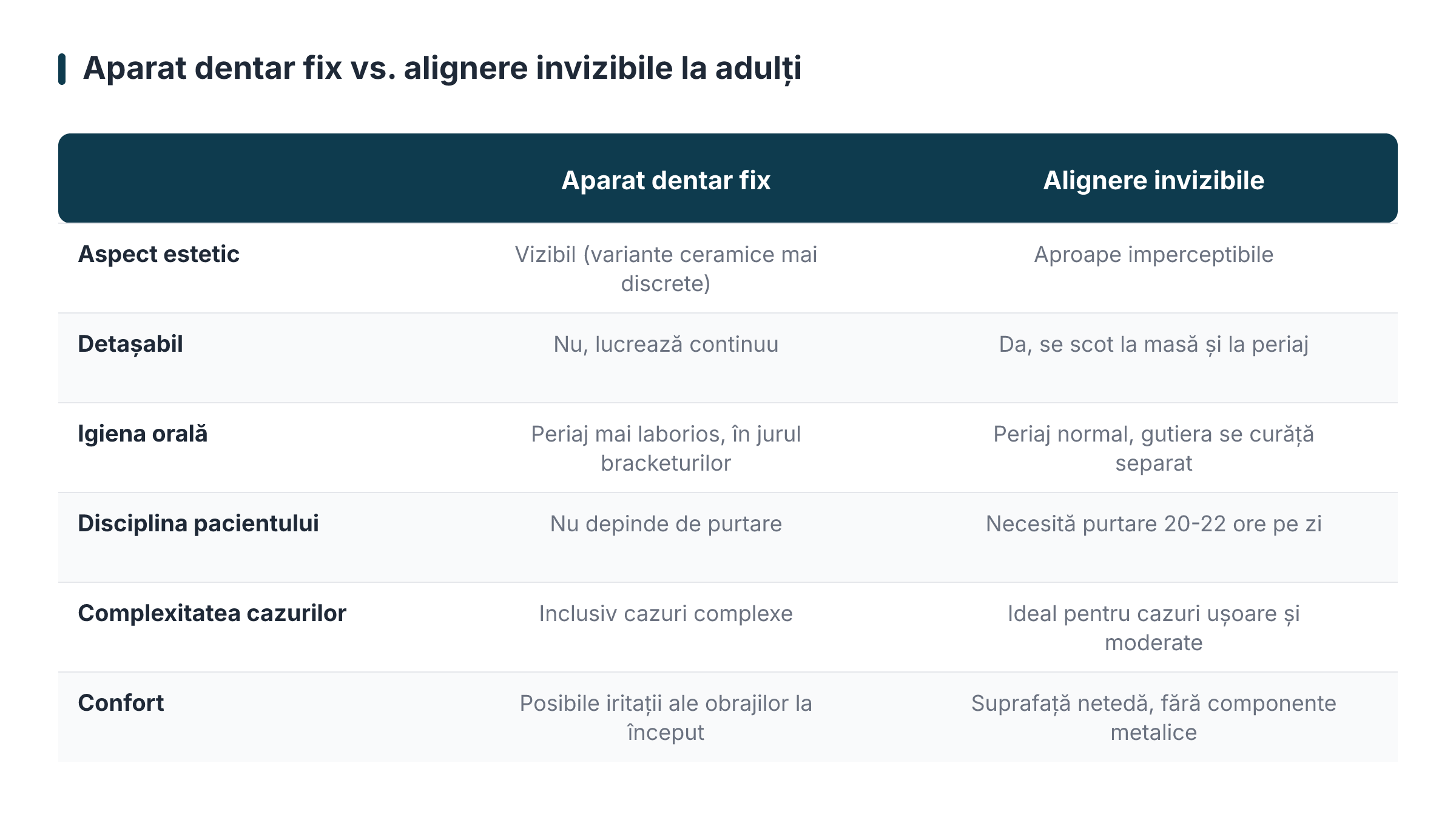
- Initial discussion: what bothers you, since when, what expectations do you have. Medical and dental history matters: previous treatments, extractions, prosthetic work, bruxism (teeth grinding).
- Clinical examination: the orthodontist evaluates the alignment of the teeth, the bite in all planes, the condition of the gums, the temporomandibular joint and the facial profile.
- Imaging investigations: usually a panoramic radiograph, and depending on the case a profile teleradiograph, which shows us the relationship between the jaws and the growth direction of the bone structures.
- Fingerprint or 3D scan: it replaces classic impressions with paste and gives us the digital model of the arches, on which we plan the dental movements.
- Treatment plan: at the next visit you receive the diagnosis, the treatment options with the advantages and limitations of each, the estimated duration and the related costs.
An essential aspect in adults: the teeth must be healthy before orthodontic movement begins. Caries, tartar and gingival inflammation are resolved first. If necessary, we coordinate the stages with our colleagues from the other specialties, within the same clinic, where we cover the entire range of dental treatments in Sector 6, from professional sanitation to prosthetics and surgery.
What if you are missing teeth or have prosthetic work?
The situation is common in adults and does not exclude orthodontics, on the contrary. Orthodontics often sets the stage for quality prosthetic rehabilitation.
If you've been missing a tooth for a longer period of time, the neighbors probably gravitated toward the vacant space. A dental implant it needs correctly sized space and neighboring teeth in correct position. Orthodontics can reopen or redistribute this space before implantation, so that the prosthetic result is stable and hygienic.
Important to know: Implants and ankylosed teeth do not move orthodontically. That's why the order of the stages matters, and the plan is made from the beginning in a team, orthodontist plus prosthetist or surgeon. Existing crowns and veneers usually do not prevent treatment with aligners, and in the case of fixed appliances there are fixing solutions adapted to ceramic surfaces.
At the end of the orthodontic treatment comes the retention stage: appliances or retainers that keep the teeth in their new position. Contentia is long-term, because teeth have a natural tendency to migrate throughout life. It's a simple but essential step that we discuss with each patient from the very beginning of the plan.
Why you should not postpone the orthodontic consultation
Untreated orthodontic problems do not usually remain static. Crowding tends to intensify, tooth wear progresses slowly but irreversibly, and areas that are difficult to sanitize continue to accumulate bacterial plaque. The earlier the assessment occurs, the simpler and shorter the treatment options.
On the other hand, not every deviation from perfect alignment requires treatment. There are patients to whom, after the consultation, we honestly tell them that their situation is stable and that orthodontic treatment would bring minor benefits. The role of the consultation is exactly this: to transform an uncertainty ("do I need the device?") into a clear answer, based on radiographs, measurements and clinical experience.
If you have found yourself in the signs described above, we encourage you to schedule an orthodontic consultation in our Dental Science clinic, in Militari, Sector 6. Our orthodontic team can show you, on digital simulation, how your smile would evolve with aligners or a fixed appliance, before making any decision.
Frequently Asked Questions
I am 40 years old. Is it still worth wearing braces or aligners?
Yes. Teeth move through bone remodeling, a biological process active at any age as long as the teeth, bone and gums are healthy. In our practice, we frequently treat patients 40, 50 and even over 60 years old. The difference with teenagers is that the planning takes into account prosthetic work, possible gum recession and missing teeth, and the treatment may take a little longer. Many adults choose aligners precisely for discretion in the professional environment.
Does orthodontic treatment in adults hurt?
Most patients describe pressure or sensitivity when chewing in the first few days after fitting the appliance or after changing each pair of aligners. This sensation is a sign that the teeth have started to move and usually subsides within a few days. Aligners are often perceived as more comfortable than fixed appliances because they have no metal components that can irritate the cheeks. If unusual or persistent discomfort occurs, the orthodontist adjusts the plan.
How long does orthodontic treatment last for an adult?
The duration depends on the complexity of the case, the type of appliance chosen and the consistency of wear, in the case of aligners. Minor corrections, such as a relapse after teenage treatment, may resolve within months, while complex cases may require two years or more. You will receive the exact estimate after the orthodontic consultation, together with the treatment plan, based on radiographs and digital scanning.
Can I wear aligners if I have crowns, veneers or an implant?
In most cases, yes. Aligners also cover teeth with crowns or veneers, and movements are digitally planned with these restorations in mind. The important exception is implants: they are fixed rigidly in the bone and do not move orthodontically, so the treatment plan treats them as fixed points. Therefore, if you are going to get an implant and you are also considering orthodontics, it is ideal to do the orthodontic consultation first, to establish the correct order of the stages.
Do I have to deal with cavities and gum problems before braces?
Yes, this is the rule in responsible orthodontics. Dental movement in an area with active cavities or inflamed gums increases the risk of complications. Before starting, we perform professional hygiene, treat existing cavities and, if there is periodontal damage, stabilize it first. As a general dentistry clinic with a focus on orthodontics, we can coordinate all these stages in the same place, without traveling between different offices.
What should I bring to my first orthodontic consultation?
No special training is needed. If you have recent dental x-rays, less than 6-12 months old, it is helpful to bring them, as well as information about previous orthodontic or prosthetic treatments. The rest, we take care of everything: clinical examination, X-rays if necessary and digital scanning of the teeth. Just come with your questions, and at the end you will know if you need treatment and which options are right for you.
This article is informative and does not replace professional advice. For a personalized diagnosis and treatment plan, schedule a consultation.