

#Orthodontics with aligners
Invisible braces: aligning your teeth with clear aligners

Invisible braces correct the position of the teeth without metal brackets and without any visible impact on your smile during treatment. For many adults and teenagers this is the main reason they choose orthodontic treatment with clear aligners: the teeth move into line gradually, and the people around you notice the result, not the appliance.
Interest in this type of treatment has grown steadily over the past few years, both in Bucharest and across the country. Patients are looking for a discreet orthodontic solution that fits their professional and social life, imposes no dietary restrictions and keeps oral hygiene simple.
At Dental Science, a clinic founded in 2009 by Dr. Alina Gheorghiu, a specialist in orthodontics and dentofacial orthopaedics, invisible brace treatments are planned digitally from the first appointment through to completion. This guide covers everything you need to know before deciding: what invisible braces are, what types exist, who they are recommended for, how treatment unfolds step by step and which factors influence the results.
What to expect

Clear aligners, practically unnoticeable at conversational distance
3D digital planning and a simulation of the result before you start
No dietary restrictions: the trays come out at mealtimes and for brushing
Infrequent check-ups, every 6 to 10 weeks, lasting 15 to 30 minutes
#What it is
What invisible braces are and how they work
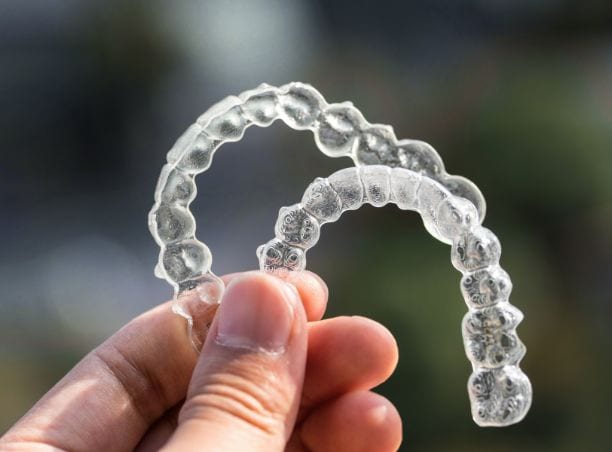
An invisible brace is an orthodontic system made up of a series of clear trays, called aligners, manufactured individually for each patient's case. Every aligner is designed to produce small, controlled and progressive tooth movements. Worn in the order set by the orthodontist, the aligners move the teeth step by step towards the planned position.
The principle is simple: the aligner applies constant, gentle pressure to the teeth being moved. The bone around the root remodels gradually and the tooth shifts in the intended direction. Once an aligner has done its job, the patient moves on to the next one in the series, usually every 1 to 2 weeks.
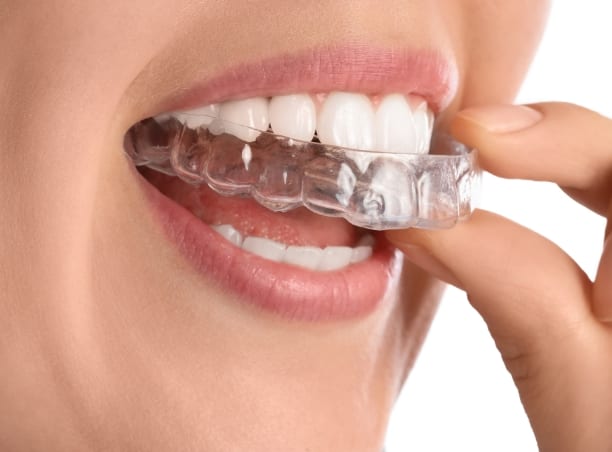
The essential difference from conventional fixed braces is that aligners are removable. They come out at mealtimes and for brushing, then go back in. There are no brackets bonded to the teeth and no metal archwires, which means less irritation of the soft tissue and far simpler oral hygiene.
The materials used for aligners today combine transparency with stain resistance and a smooth surface that is comfortable against the gums. At normal conversational distance, a well-made clear brace goes practically unnoticed.
Treatment always begins with digital planning. At Dental Science, in Bucharest, every case starts with a 3D scan taken with the MEDIT intraoral scanner, which replaces conventional impressions entirely. Working from that scan, the orthodontist maps out the full path of the teeth, and the patient can see a simulation of the result before starting.


Types of invisible braces available today
The term invisible braces covers several orthodontic options with differing degrees of discretion. It is worth knowing all of them before your consultation, so you can discuss the choice with your orthodontist on an informed footing.
Clear aligners
Aligners are what the phrase invisible braces most often refers to. They are removable, transparent trays, worn at least 22 hours a day and replaced at regular intervals. Several aligner systems are available, among them Spark and Invisalign, which work on the same principle of sequential trays but differ in material, manufacturing method and the associated clinical protocols.
Dental Science works with the Spark system developed by Ormco, and Dr. Alina Gheorghiu is accredited in Spark directly by the manufacturer, with training that includes the Spark Discovery and Spark Discovery Plus programmes and the advanced Master COIP course.
Aesthetic braces with ceramic or sapphire brackets
Fixed braces with tooth-coloured ceramic or sapphire brackets are regarded by many patients as a discreet option. They are not genuinely invisible, however: the brackets are still visible close up, and the dietary restrictions and hygiene rules of fixed braces still apply.
Choosing between these options is not a matter of fashion but of clinical indication. The complexity of the case, the patient's age, lifestyle and self-discipline all weigh on the orthodontist's final recommendation.
#who it is for
Who invisible braces are recommended for
Clear aligners cover a broad range of orthodontic situations, from mild alignment problems through to moderate or complex irregularities. These are the main indications:
- Crowded teeth. When there is not enough room on the arch and the teeth overlap, aligners can create space and guide each tooth into the correct position.
- Gaps between teeth. A diastema and other spacing, meaning the visible gaps between teeth, can be closed gradually with clear aligners.
- Bite problems. A deep bite, an open bite or a crossbite can be corrected with aligners in mild and moderate cases. Left untreated, these problems can in time contribute to muscle and joint pain, accelerated tooth wear or worsening periodontal disease. For complex situations the orthodontist may recommend a combined approach.
- Relapse after previous orthodontic treatment. Patients who wore braces in the past and whose teeth have since drifted, usually because retainers were not worn as instructed, can benefit from discreet realignment with aligners.
- Adults and teenagers. Invisible braces suit both adults who would rather not have visible treatment in a professional setting and teenagers who prefer an alternative to conventional fixed braces.
There are limits, too. Severe skeletal discrepancies, certain large tooth rotations or cases that call for complex tooth movements may fall outside what aligners can achieve, or may require additional treatment stages. That is why the decision always follows a full orthodontic assessment, never an online self-assessment.
The stages of aligner treatment at Dental Science
Treatment with invisible braces follows a clear protocol, planned digitally from beginning to end. Here is how it unfolds, stage by stage, at the Dental Science clinic in Bucharest:
1. Initial consultation and full assessment
It all starts with a clinical examination by Dr. Alina Gheorghiu, who reviews the radiographs, the photographs and the overall condition of the teeth. This is also when your expectations and the goals of treatment are discussed. At this stage it becomes clear whether aligners are the right solution for the case, or whether a different orthodontic approach would serve you better.
2. 3D digital scanning
If you are a suitable candidate, the next step is a complete digital scan of both arches with the MEDIT intraoral scanner. The scan takes a few minutes, is comfortable and does away with conventional impression materials.
3. A personalised treatment plan
Working from the scan, the orthodontist designs the treatment plan: the number of aligners, the estimated duration and the tooth movements planned for each stage. You see a simulation of the final result before starting, which keeps expectations realistic and makes the whole process transparent.
4. Manufacturing and delivery of the aligners
The aligners are made to measure in specialist laboratories, based on the approved digital plan. Each tray is designed to deliver exactly the movements set out in the treatment plan.
5. Wearing the aligners and regular check-ups
You wear each set for at least 22 hours a day and change it according to the plan, usually every 1 to 2 weeks. Check-ups take place every 6 to 10 weeks, last 15 to 30 minutes and include a review of your progress.
6. Finishing treatment and retention
After the final aligner you receive a retainer, the appliance that holds the result in place over the long term. Without retention the teeth tend to drift gradually back towards their original position. Monitoring continues after active treatment ends, so that the result lasts.
How long treatment takes and what to expect
A course of treatment with invisible braces takes between 6 and 24 months in total, depending on the complexity of the case. Mild cases, such as minor crowding at the front or an isolated diastema, can finish within 6 to 9 months. Moderate cases, with multiple movements across both arches, usually take between 12 and 24 months.
The first days with a new set of aligners can bring a feeling of pressure on the teeth. That is a normal sign that the tray is working, and the discomfort usually passes within 2 to 3 days. Speech may be slightly affected while you adjust, but most patients adapt quickly.
Throughout treatment there are no dietary restrictions, because the aligners come out at mealtimes. The one rule that matters is brushing before you put the trays back in, so that no food is left between the aligner and the tooth. Daily hygiene means normal brushing and floss or a water flosser, with none of the extra manoeuvring required around brackets.
Looking after the trays is just as straightforward. Rinse them with water every time you take them out and clean them daily with a separate brush and mild soap, never with hot water, which can distort them. Coloured drinks such as coffee or red wine are best consumed with the aligners out, to keep the material clear for the whole time you wear it.
One point to remember: the results depend directly on how disciplined you are about wear time. Aligners taken out too often, or worn for less than the 22 hours a day, lengthen treatment and can undermine the planning. Your orthodontist gives you the estimated duration at the planning stage, so you know from the outset what to expect.
#results
Factors that influence the results
As with any medical treatment, orthodontic results with aligners can vary depending on several factors.
- The starting clinical picture. The degree of crowding, the type of malocclusion and the condition of the gums influence both the duration and the complexity of the treatment plan. Teeth with compromised bone support call for a more cautious approach.
- Patient compliance. Daily wear time is the factor most firmly within the patient's control. Keeping to the minimum of 22 hours a day and changing aligners on schedule keeps treatment on track.
- Oral hygiene. Good hygiene protects the enamel and the gums throughout treatment. Decay or gum inflammation appearing along the way can make additional treatment necessary.
- An interdisciplinary approach. Related problems sometimes surface during orthodontic treatment: a cavity, a periodontal issue, a need for root canal treatment. At Dental Science these are dealt with in the same clinic, without interrupting orthodontic progress, thanks to the full range of services on offer, from laser periodontics to endodontics under the microscope.
- Retention after treatment. Wearing the retainer as instructed is what keeps the result in place over the long term. Giving up on retention too early remains one of the common causes of relapse.
About the Dental Science medical team in Bucharest
Orthodontics with aligners calls not only for technology but, above all, for a properly conceived treatment plan. Digital planning is a tool; the quality of the result depends on the clinician who designs and supervises it.
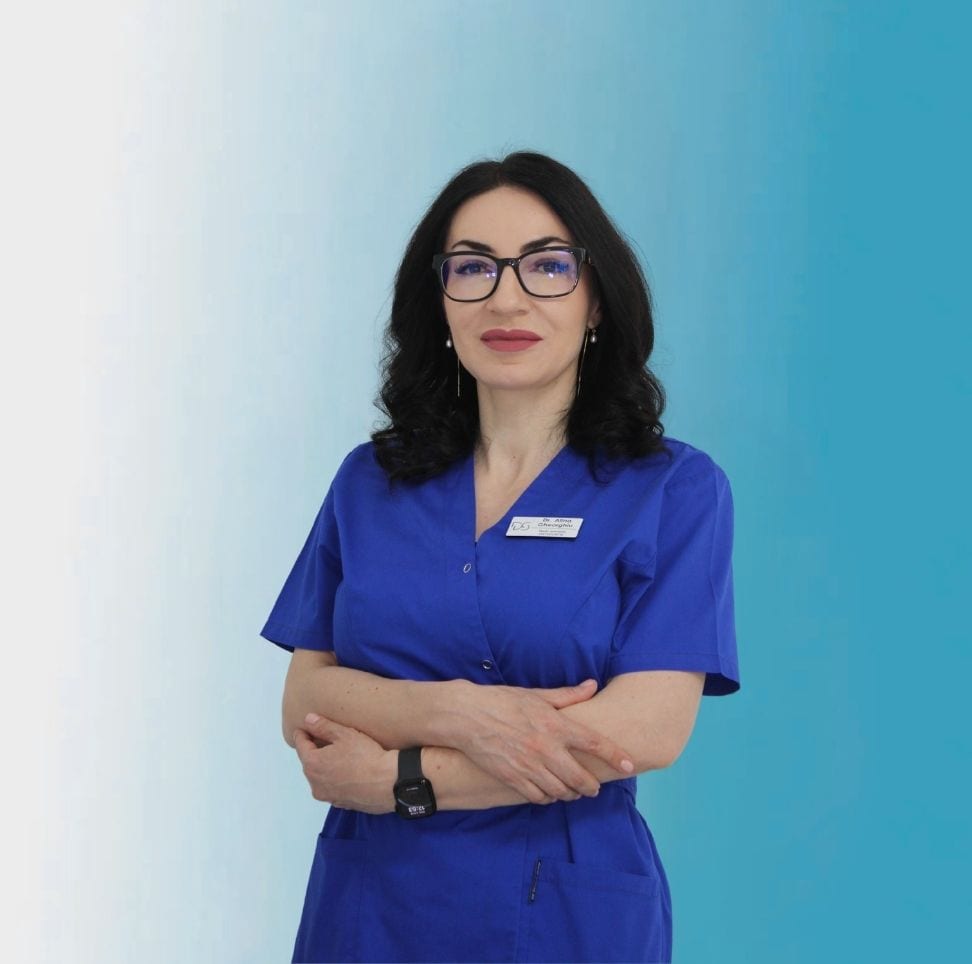
Dr. Alina Gheorghiu, the founding clinician of Dental Science, has more than 22 years of experience in dentistry and orthodontics. She founded the clinic in 2009 with the aim of changing the mindset that you only go to the dentist when something hurts. She is accredited in Spark by Ormco, having completed the Spark Clear Aligners accreditation, the Spark Discovery and Spark Discovery Plus programmes, the advanced Master COIP course and certification in aligner biomechanics through the Romanian Society for Aligners.
The clinic is at Bd. Iuliu Maniu 74-76, in the Lujerului area of sector 6, easily reached by metro from anywhere in the city. Patients from Bucharest and the surrounding towns receive a detailed quotation before treatment begins, along with financing options and payment in instalments. If you live nearby, you can also read the page devoted to invisible braces in sector 6.
Frequently asked questions about invisible braces
Today's aligners are made from materials with high transparency and good resistance to staining. At normal conversational distance they are very hard to spot. Many patients tell us their friends and colleagues had no idea they were wearing braces until they mentioned it.
The cost depends on the complexity of the case, the number of aligners needed and the length of treatment. An accurate figure can therefore only be given after the orthodontic assessment and the digital scan. At the end of your consultation you receive a detailed quotation, and the pricing page sets out the clinic's services.
Each time you change to a new set you may feel mild pressure on the teeth for 2 to 3 days. That is the sign that the teeth are moving according to plan. The sensation is generally much milder than the discomfort associated with fixed braces with brackets and archwires.
Yes. The aligners come out completely at mealtimes, so there are no dietary restrictions. The only requirement is to brush or rinse your teeth before putting the trays back in, to avoid trapping food debris under the aligner.
Contact the clinic straight away. Depending on the stage you have reached, the orthodontist may advise wearing the previous set until a replacement arrives, or moving on to the next set. It is important not to go without aligners for long periods, because the teeth can start to move in an uncontrolled way.
Fixed braces use brackets bonded to the teeth and archwires that are adjusted periodically. Aligners are removable clear trays that you change progressively at home, according to the plan. Aligners offer more discretion, simpler hygiene and meals without restrictions, while fixed braces remain the indicated option in certain complex cases.
Book an assessment for invisible braces in Bucharest
The first step towards an aligned smile is a full orthodontic assessment. At your consultation you talk directly to Dr. Alina Gheorghiu about your goals, go through a thorough clinical examination and, if you are a suitable candidate for aligner treatment, have a demonstration digital scan. You leave the clinic knowing exactly how long treatment should take, what the stages are and what it costs, all set out in a detailed quotation.
Appointments can be made by telephone or through the contact page.
Dental Science
Bd. Iuliu Maniu 74-76, Bl. 5, Entrance A, Flat 2, Sector 6, Bucharest, Lujerului area
Telephone: +40 744 490 624
Email address: info@dentalscience.ro
Opening hours:
Monday, Tuesday, Thursday: 10:00 - 20:00
Wednesday: 12:00 - 20:00
Friday: 10:00 - 16:00
services
“Excellent dental experience! The team is super attentive and the treatment was painless.”



“Excellent dental experience! The team is super attentive and the treatment was painless.”
Don't put off taking care of your smile. Schedule today and discover modern treatments, planned together with you, for a new, natural and lasting result.