
#BLOG · 13 August 2026
What does the dentist check when checking the child before school starts?
Why is a dental checkup important before starting school?
At the dental check-up before the start of school, the doctor checks four essential things: the presence of cavities on the baby teeth and on the newly erupted permanent teeth, the stage of tooth eruption (if the teeth are coming out in order and at the right time), the quality of oral hygiene and the first signs of alignment or bite problems. Even now, preventive measures such as professional fluoridation or sealing of permanent molars can be applied. It is a simple, painless consultation that lasts on average 20 to 30 minutes.
August is, in our experience in Dental science clinic, from Sector 6, the month when parents have the most time to solve this control without haste. Once school starts, the child's schedule gets crowded, and a problem discovered late, for example a deep cavity that hurts during classes, becomes much more difficult to manage.
The age of 6-7 years, that is exactly the period of entering the preparatory class or the first grade, coincides with a crucial dental moment: the eruption of the first permanent molars and the beginning of the replacement of milk teeth. That is why the control during this period is not just a formality, but a real necessity of prevention.
What the doctor checks, step by step, when checking the child
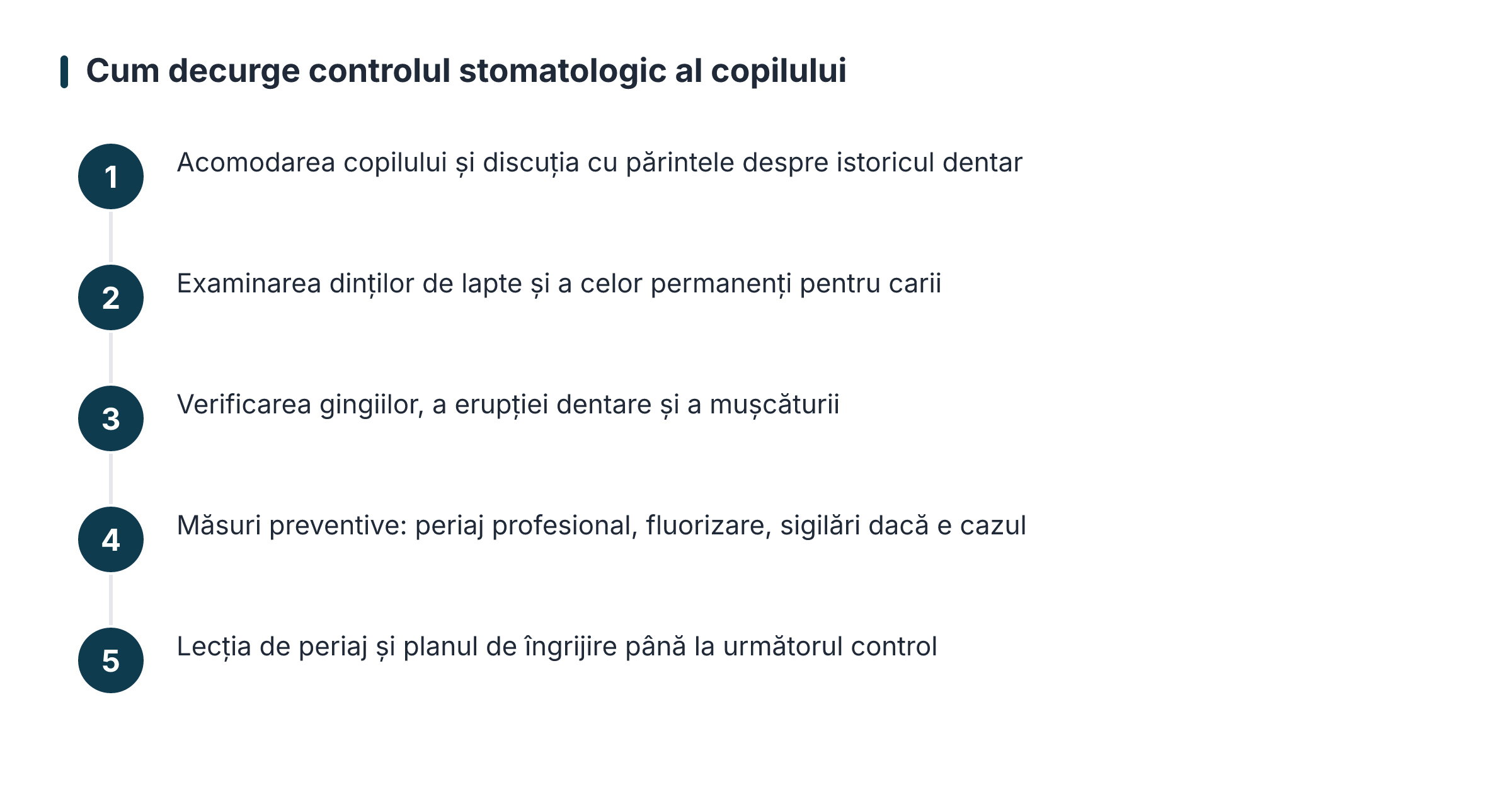
Many parents ask us what actually happens in the office, especially if it is among the child's first visits to the dentist. Here are the steps we usually follow:
Examination of milk and permanent teeth
The doctor examines each tooth individually with the mirror and dental probe, looking for cavities, chalky white spots (the sign of demineralization, i.e. the early stage of decay), cracks or damaged old fillings. Special attention is given to the milk molars, which have deep grooves where bacterial plaque easily accumulates, and the first permanent molars, which erupt around the age of 6, behind the last milk teeth.
A detail that many parents do not know: these 6-year-old molars do not replace any baby teeth. They appear directly behind the arch and are often mistaken for temporary teeth, which is why their caries are sometimes ignored. However, they are permanent teeth, which must last a lifetime.
Assessment of tooth eruption and tooth change
At 6-7 years, the period of mixed dentition begins, in which baby teeth coexist with permanent teeth. The doctor checks whether the baby teeth are mobilizing and falling out at the right time, whether the permanent teeth are erupting in the right direction and whether there are situations that require intervention, for example a permanent incisor erupting behind the baby tooth that has not yet been exfoliated, a common appearance and usually easy to manage.
Checking the gums and soft tissues
A child's healthy gums are pink and do not bleed when brushed. The doctor checks for signs of gingivitis (inflammation of the gums caused by plaque), canker sores, frenulums (those bands of tissue that connect the lips and tongue to the gums), and the lining of the cheeks. In children, bleeding gums are almost always a signal that brushing needs to be corrected, not a disease in itself.
Assessment of bite and early orthodontic signs
As an orthodontist, I consider this stage one of the most valuable of the 6-7 years of control. We check how the arches close over each other, if there is crowding, open bite, reverse bite or abnormal spaces. We also now ask about habits such as finger-sucking, mouth breathing or interposing the tongue between the teeth, which can influence the development of the jaws.
Caught early, many alignment problems can be corrected with simple interventions. And for teenagers, for whom the problems have persisted, there is today also invisible braces optionse, much more discreet than classic devices.
Decay in milk teeth: do they really need to be treated if the teeth change anyway?
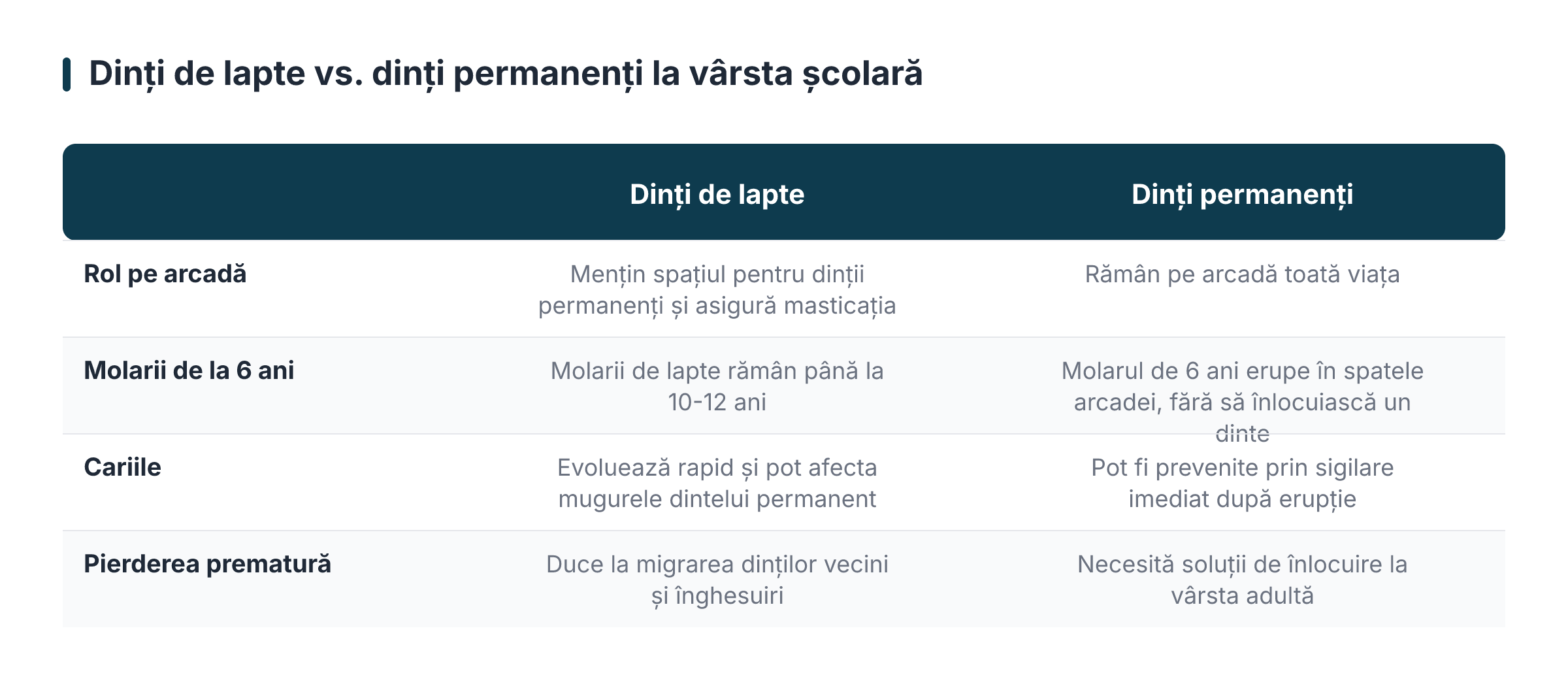
Yes, cavities in baby teeth need to be treated, and this is probably the most common discussion we have with parents. Milk teeth are not "trial": temporary molars remain in the arch until 10-12 years, so a cavity that appeared at 6 years has plenty of time to evolve.
Here's why healthy baby teeth matter:
- Save space for permanent teeth. A prematurely lost milk molar leaves neighboring teeth to migrate and the permanent tooth no longer has room to erupt properly, often leading to crowding and the need for orthodontic treatment later.
- The infection can be transmitted of the underlying permanent tooth bud, affecting a tooth that has not even erupted yet.
- The pain affects chewing, sleep and concentration the child at school. A child with toothache eats selectively and has a harder time learning.
- The appearance of the front teeth it influences the child's confidence, especially at the age when peers notice everything.
Caries treatment in children today is quick and gentle, and the earlier the caries are discovered, the simpler the intervention. A white spot of demineralization can sometimes be stopped only by fluoridation and hygiene correction, without any milling.
What preventive measures can be taken even at this control?
Pre-school control is not limited to checking. Often times, we also apply age-appropriate preventive measures.
- Professional brushing, a gentle cleanser that removes plaque and stains, adapted to the child's age.
- Professional fluoridation, the application of a fluoride varnish or gel that strengthens the enamel and reduces the risk of caries. It is a completely painless procedure that takes a few minutes.
- Sealing of permanent molars, that is, covering the deep grooves of the 6-year-old molars with a protective fluid material, before bacteria settle there. It is one of the most effective preventive measures at this age, provided the molar is fully erupted and healthy.
- Brushing lesson, in which we show the child, on models and on their own teeth, how to brush correctly. Children remember much better when they are shown practically than when they are told theoretically.
If during the check-up we discover problems that require treatment, together with the parent we establish a phased plan, starting with what is urgent and continuing at the child's pace. You can see the full range of dental treatments available in our clinic in Sector 6.
How to prepare your child for control, without fear
The parent's attitude greatly influences the child's experience at the dentist. We recommend some simple rules, verified in years of practice with small patients.
- Talk about the visit naturally and positively: "let's go count the teeth and see how strong they are". Avoid wording like "don't be afraid, it doesn't hurt", which suggests to the child that they have something to be afraid of.
- Do not transfer your own experiences. If you have emotions about the dentist, do not tell the child. Dentistry today bears very little resemblance to that of 20-30 years ago.
- Schedule your visit in the morning, when the child is rested and cooperative, not in the evening after a long day.
- Don't use the dentist as a threat ("if you don't brush your teeth, I'll take you to the dentist to give you an injection"). It is the surest way to create a phobia.
- Let the doctor lead the discussion in the cabinet. Our team is used to gaining children's confidence at their own pace with age-appropriate explanations.
If the first visit is just for accommodation, without any procedure, that's perfectly fine. A child who leaves the dentist with a smile will be happy to come next time, and this is the most valuable long-term result.
Oral hygiene of the school-age child: what we recommend to parents
Cabinet control is only half the equation. The other half happens at home every day, and the start of school is a good time to establish proper oral hygiene routines in children.
- Brush twice a day, in the morning and necessarily in the evening, before going to bed, with fluoride toothpaste, adapted to the age.
- Brushing supervision or finishing by the parent until around the age of 7-8. The child's dexterity is not yet sufficient for a thorough brushing, even if the enthusiasm is there.
- Watch out for school snacks: sugary juices, biscuits and wafers often consumed between meals are the main driver of cavities. Prefer water, whole fruits, cheeses and sandwiches.
- Dental floss it can be introduced gradually, especially between the molars, where the brush does not reach. An even easier option to use is the oral douche or the oral irrigator.
- Regular checks, generally every 6 months, or more often if the doctor recommends, depending on the child's caries risk.
For parents in Militari and the rest of Sector 6 who are looking for a children's dental practice close to home, our team is looking forward to seeing you. A preventive check-up done in August means a quiet September, without dental surprises, and the child starts school with a healthy smile. Scheduling a specialist consultation is the first step, and we build the rest together, visit by visit.
Frequently Asked Questions
At what age should the child be taken to the dentist for the first time?
The general recommendation is that the first visit should take place around the age of 1 year or shortly after the eruption of the first teeth. If this time has passed, as it frequently does, the best time is now. The period before starting school, at 6-7 years old, is essential because that's when the first permanent molars erupt and the replacement of milk teeth begins. The first visits can only be for accommodation, without procedures, precisely for the little patient to gain confidence.
Are cavities in milk teeth treated or do we wait for the tooth to fall out?
Baby tooth decay should be treated, not waited for. Temporary molars remain in the arch for up to 10-12 years, during which time untreated decay can cause pain, infection and even damage to the permanent tooth bud below. Additionally, the premature loss of a baby tooth leaves neighboring teeth to migrate and the permanent tooth no longer has room to erupt properly, often leading to crowding and the need for orthodontic treatment later.
What is dental sealing and when is it done in children?
Sealing is a completely painless, preventative procedure in which the deep grooves on the surface of the molars are covered with a protective fluid material before plaque can cause cavities. It is especially recommended for permanent molars of 6 years, as soon as they have fully erupted and are healthy. The procedure takes a few minutes per tooth, does not require anesthesia or milling, and is one of the most effective methods of preventing tooth decay at school age.
How long does a child's dental checkup take and does it hurt?
A preventive check-up takes on average 20 to 30 minutes and is painless. The doctor examines the teeth with a mirror and probe, checks the gums, eruption and bite, then discusses the findings and possible recommendations with the parent. If fluoridation or fillings are needed, they are also painless. The actual treatments, if necessary, are scheduled separately, so that the child does not associate the control with unpleasant procedures.
My child has crooked teeth. At what age can orthodontic treatment begin?
The first orthodontic consultation is recommended around the age of 7, when the mixed dentition allows early detection of jaw alignment and development problems. That doesn't mean treatment necessarily starts then: in many cases we just monitor, and in others we intervene with simple growth guidance devices. The optimal moment is determined individually, depending on the problem of each child, which is why the orthodontic evaluation is a natural part of the preventive control at this age.
How often should the child come for a dental check-up?
The general rule is a checkup every 6 months. For children with a high risk of caries, with poor hygiene or in the process of changing teeth, the doctor may recommend more frequent visits, for example every 3-4 months. Regular visits allow cavities to be detected at an early stage, when treatment is simple and quick, and maintain the child's habit of going to the dentist without fear, which is extremely important for his oral health as an adult.
This article is informative and does not replace professional advice. For a personalized diagnosis and treatment plan, schedule a consultation.