

#BLOG · 20 August 2026
Spark aligners or other clear aligners: how do they work and who are they suitable for?
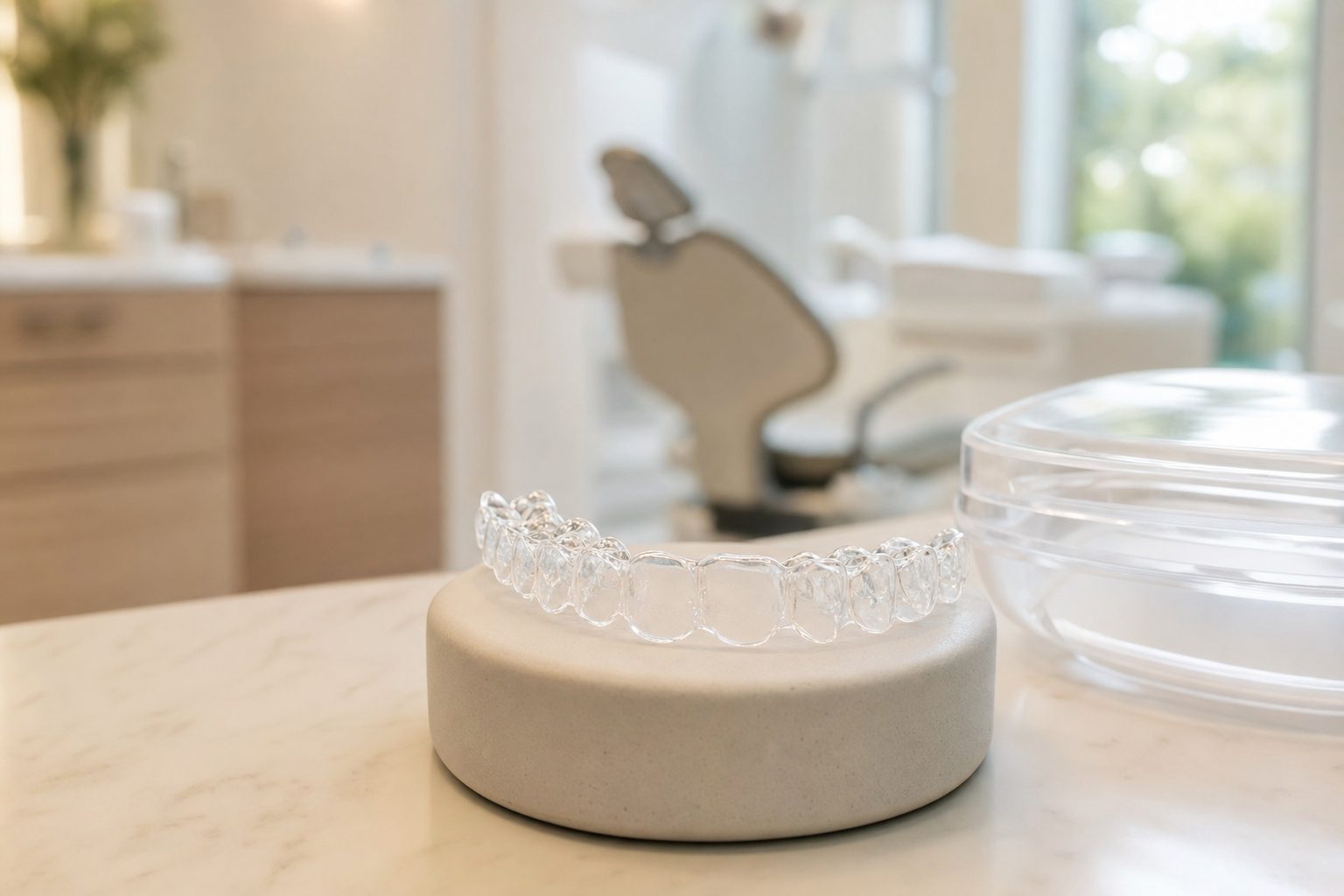
What are Spark aligners and how do clear mouthguards work?
Spark aligners are clear braces made of a material called TruGEN, developed specifically for orthodontics, which gradually move teeth into the correct position through a series of braces changed every one to two weeks. They work on the same principle as other well-known systems, such as Invisalign or ClearCorrect, but they differ in the clarity of the material, the comfort of the edges and the way they transmit the forces on the teeth. They are suitable for teenagers and adults with dental crowding, gaps between teeth or mild to moderate bite problems, and in the hands of an experienced orthodontist can solve even more complex cases.
Regardless of the brand, the principle is the same: based on a digital scan of the teeth, the orthodontist plans the movement of each tooth on the computer, and the patient receives a set of numbered trays. Each tray exerts gentle and controlled pressure on the teeth, moving them by fractions of a millimeter. Worn 20-22 hours a day, braces transform a digital plan into an aligned smile, without wires or metal brackets.
In our clinic in Bucharest we currently work with invisible aligners Spark, precisely because clinical experience has shown us that the material and digital planning of this system give us very good control over dental movements.
Spark, Invisalign, ClearCorrect: How do materials and technology differ?
To the patient, all transparent vials look the same at first glance. The real differences are seen in the material, in the precision with which the mouthguard covers the tooth and in the digital tools that the doctor has at his disposal.
The material: why it matters what the aligner is made of
The material of a mouthguard determines three essential things: how constant the force applied to the teeth is, how transparent the mouthguard remains over time and how comfortable it is to wear.
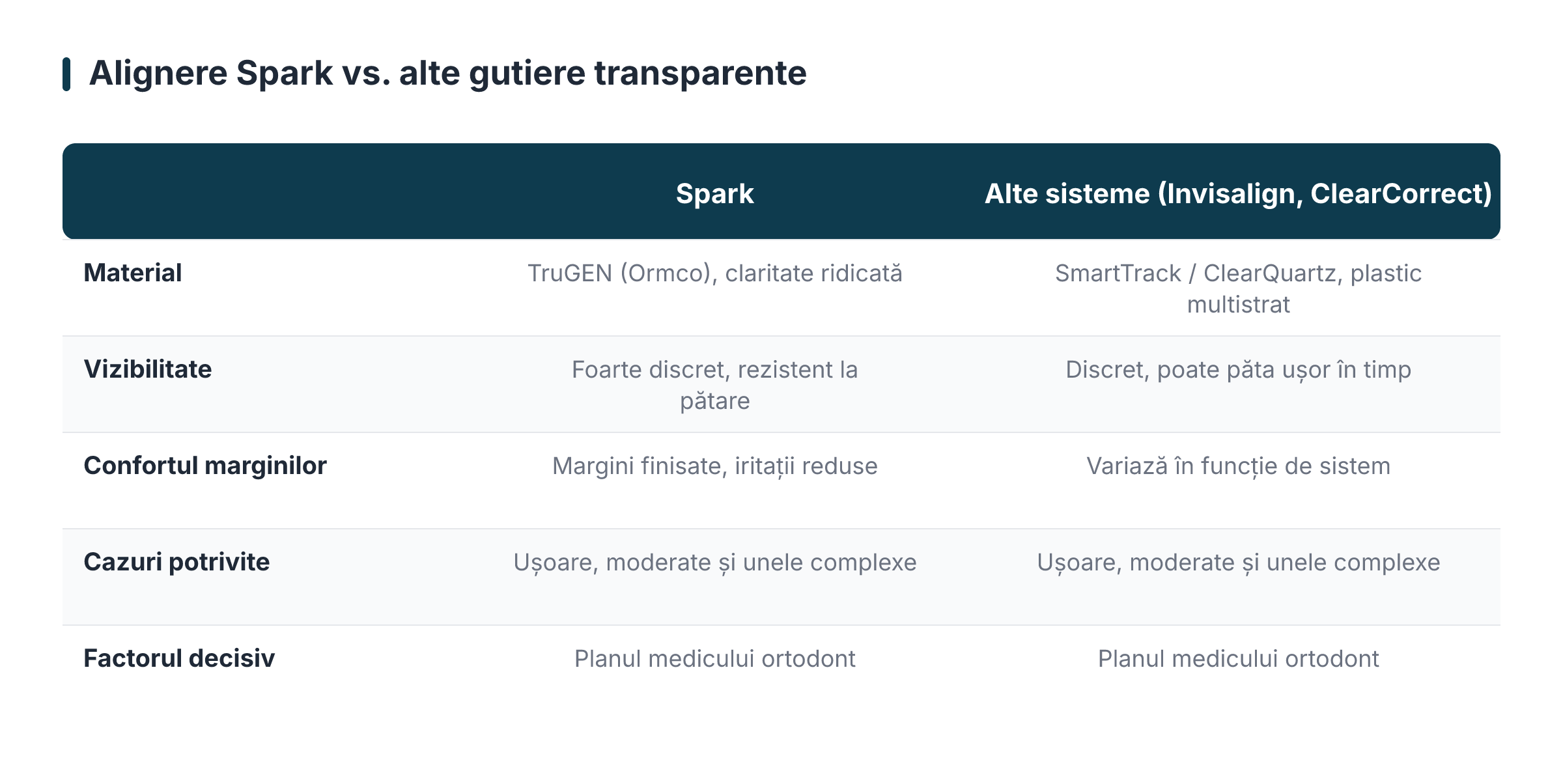
- Spark uses TruGEN, a material developed by the company Ormco, known for decades for fixed dental appliances. It is appreciated for its high sharpness, resistance to stains (coffee, tea) and edges cut and finished so that it is less irritating to the gum and cheeks.
- Invisalign uses SmartTrack material, an elastic multi-layer plastic with a long history of use, being the oldest system on the market.
- ClearCorrect uses ClearQuartz material, also a multi-layer material, with a straight edge of the tray cut above the gingival contour, which some clinicians believe helps tray retention.
In our practice, patients notice two aspects of Spark in particular: the mouthpieces are very little visible during speech and remain clear throughout the wearing period, which matters a lot for professionally active adults in Bucharest who want a invisible braces in the true sense of the word.
Digital planning and physician control
Another differentiator is planning software. The Spark system gives the orthodontist detailed control over each step: we can adjust the force application points, the shape and position of the attachments (small composite points applied to the teeth that help the brace grip the tooth) and the rhythm of the movements. Invisalign and ClearCorrect have similar platforms, each with its own peculiarities.
The practical conclusion for the patient: the final result depends less on the logo on the box and more on the diagnosis and treatment plan made by the orthodontist. The system is the tool, the doctor is the one who leads the treatment.
Who are Spark aligners suitable for?
Spark aligners cover a wide range of orthodontic problems, from minor cosmetic corrections to moderate cases and, with careful planning, some complex cases. Typical candidates in our practice are:
- Adults with dental crowding who put off orthodontic treatment because they didn't want visible brackets in the office or at appointments.
- Patients with spaces between teeth (diastemas) that want their controlled closure, not just masking with facets.
- Responsible teenagers, after the eruption of permanent teeth, who prefer a discreet and easy-to-sanitize version.
- Patients with orthodontic relapse, that is, teeth that have moved again after a brace worn in childhood, without subsequent retention.
- People with deep, cross or open bite in mild to moderate forms, evaluated individually at the consultation.
There are also situations where we recommend caution or other solutions: severe rotations of some teeth, significant skeletal problems of the jaws that require a surgical approach, active untreated periodontal disease or cavities that must be resolved before moving teeth. That's why orthodontic treatment always starts with a complete assessment of oral health, and if we discover gum problems, we treat them first, for example by periodontal laser therapy, and only then do we start the alignment.
An essential aspect, valid for any system of clear aligners: patient discipline. Guts only work if they are worn 20-22 hours a day. If you know about yourself that you would often take them off and forget them in your pencil case or bag, discuss this honestly at your consultation, as sometimes a fixed appliance is the more realistic choice.
What does Spark alignment treatment look like, step by step?
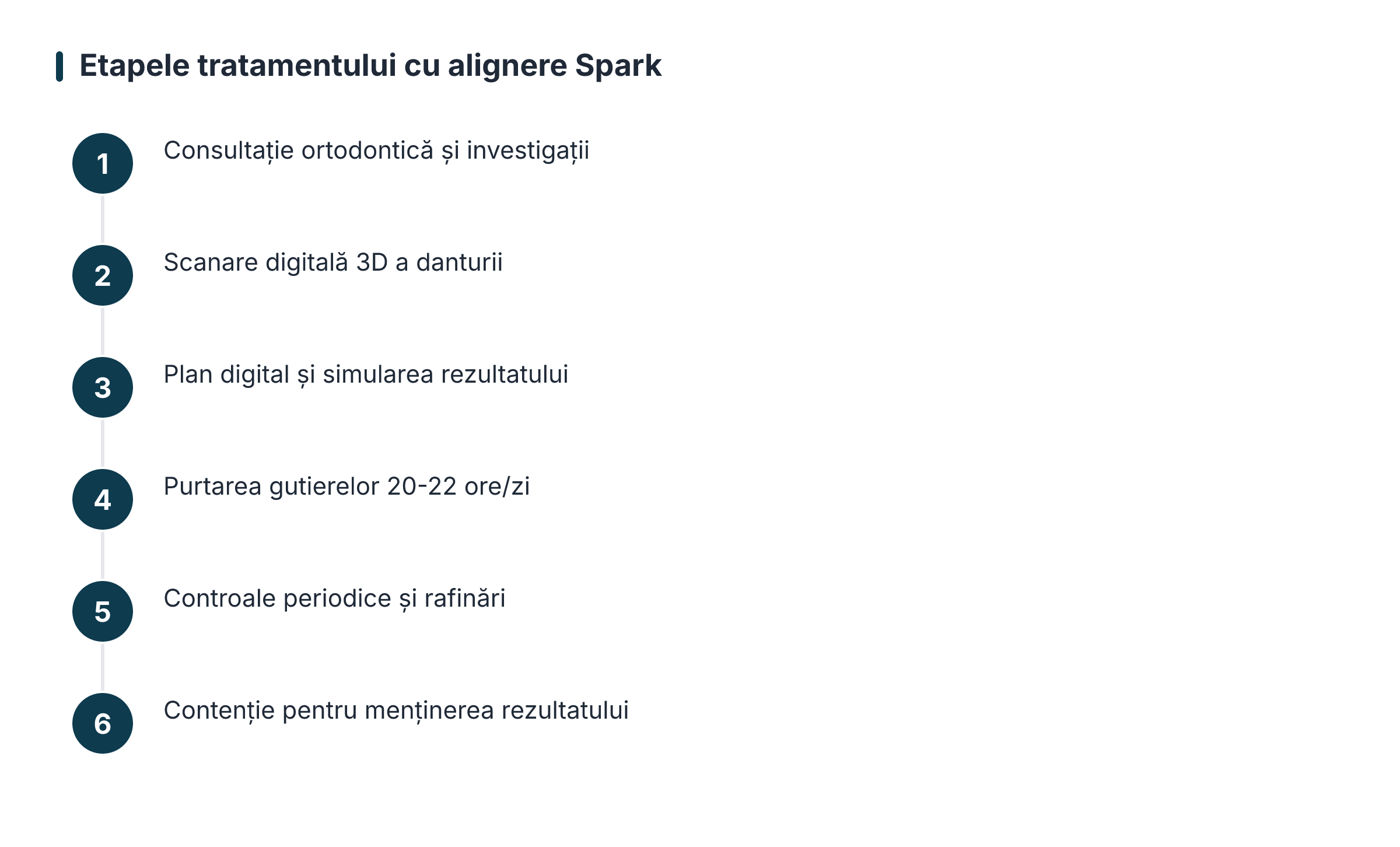
Many patients ask us how the treatment actually goes. The stages are the same regardless of the complexity of the case, only the duration and number of cases differ.
- Orthodontic consultation and investigations. We examine the teeth, gums and bite, take x-rays and photographs and discuss your expectations.
- 3D digital scanning. Replaces classic fingerprints with paste; the intraoral scanner creates a precise digital model of the teeth in minutes, without discomfort.
- The digital treatment plan. The orthodontist designs the movement of each tooth and you can see a simulation of the final result before you start.
- Wearing gloves. You receive the aligner sets and change them as directed, usually every 7-14 days, with periodic check-ups in the clinic.
- Termination and contention. At the end, we adjust the fine details, then stabilize the result with retainers or fixed retainers, so that the teeth remain in position.
The total duration varies from a few months, in simple aesthetic cases, to about a year and a half or more in complex cases. Along the way, life goes on as normal: the braces are removed at meals and when brushing, so there are no dietary restrictions as with fixed braces.
How much do Spark aligners cost compared to other clear mouthpieces?
We cannot offer a universally valid price, because each case is different, but we can explain the factors that influence the cost, regardless of the system chosen:
- The complexity of the case: a minor correction requires few vials, a moderate or complex case requires long series and sometimes additional refining vials.
- Number of arcades treated: only front teeth visible or both arches completely.
- Duration of treatment and the number of control visits included.
- Preparatory treatments: professional hygiene, treatment of caries or gingival problems before starting the alignment.
- Final contention, i.e. the aligners or retainers that maintain the result.
Between the premium clear tray systems, the differences in cost to the patient are usually smaller than the differences given by the complexity of the case itself. That is why we recommend that the decision does not start from the brand, but from a personalized treatment plan, established at an orthodontic consultation. You can also compare orthodontic options with others dental treatments available in our clinic, because sometimes the optimal plan combines teeth alignment with professional whitening or other procedures.
How do you choose the right system for you?
Our recommendation, after years of orthodontic treatments with transparent braces in Bucharest, boils down to three simple steps:
- Choose the doctor first, then the system. An orthodontist with experience in aligners will achieve good results with the tool they are most familiar with. Ask how many cases similar to yours he has treated with mouthwashes.
- Ask for a full assessment, not just a nice simulation. Digital simulation shows the destination, but X-rays, gum condition and bite analysis tell if the road is safe.
- Be realistic with your lifestyle. If discretion and comfort are a priority and you can stick to wearing it for 20-22 hours a day, clear mouthguards, and in our clinic especially the Spark system, are an excellent choice.
If you are thinking about an invisible dental appliance in Bucharest, we are waiting for you orthodontic consultation for invisible aligners in our clinic in Sector 6. We analyze your case together, show you the digital simulation of the result and determine if the Spark aligners are the right solution for the smile you want.
Frequently Asked Questions
Are the Spark aligners visible on the teeth?
Spark aligners are among the most discreet clear aligners available, thanks to the clarity of the TruGEN material. From a normal conversational distance, most interlocutors will not notice that you are wearing tights. The small composite attachments applied to some teeth are tooth-colored and remain hard to notice. For adults who work with the public or appear in meetings and presentations, this is usually the main reason why they choose clear mouthpieces over the classic fixed appliance.
Does the treatment with transparent mouthpieces hurt?
With each mouthguard change, it is normal to feel pressure or mild sensitivity on the teeth for a day or two, a sign that the teeth are moving. Most of our patients describe the sensation as much gentler than they expected and much more comfortable than with fixed braces, where the wires and brackets can irritate the cheeks. The finished edges of the Spark aligners further reduce gum irritation. If the discomfort persists for more than a few days, contact your orthodontist for a checkup.
How many hours a day should the aligners be worn?
Clear aligners must be worn 20-22 hours a day for the teeth to move according to the digital plan. Basically, you just take them out at the table, brush and floss, then put them back in. If the mouthguards stay in the box for too many hours, the teeth do not receive the necessary force, the treatment is prolonged, and the next mouthguards may no longer fit. Behavioral discipline is the most important success factor that depends solely on the patient.
Can I switch from a fixed appliance to Spark aligners?
Yes, in many situations it is possible. Some patients start with fixed braces and finish with braces, others wore braces as children, the teeth moved again over time, and now we correct the relapse with aligners. The decision depends on the remaining tooth movements and the current condition of the teeth and gums. At the orthodontic consultation, we evaluate the concrete situation and tell you if switching to alignment is the right option for your case.
What happens if I lose or break a aligner?
Don't panic, it's a common and solvable situation. Contact the clinic and, depending on when it happened, the doctor may recommend that you temporarily return to the previous splint or switch to the next one sooner until a replacement splint is ordered. It is important not to go several days without any mouthguard, because the teeth can start to move back and the treatment plan would suffer.
Do Spark aligners also work for complex cases?
Yes, in many moderate and even complex cases the Spark aligners provide very good results, provided careful digital planning and correct use of auxiliary attachments and elastics. There are limits, however: severe skeletal anomalies of the jaws, some important tooth rotations, or situations requiring extensive extractions and movements can be treated more predictably with fixed braces or combined approaches. Only an orthodontic consultation, with x-rays and bite analysis, can determine exactly what is right for you.
This article is informative and does not replace professional advice. For a personalized diagnosis and treatment plan, schedule a consultation.